I chose to redesign a block in the South Chicago neighborhood because that is where I grew up. I often took the South Chicago (93rd) Metra train to go downtown as a kid. The space has always made me jittery while I waited for the train because it is very deserted and is not cared for by the city. Vacant lots surround the bustling station. The kids that live on the block do not spend time outside because the space is not very kid friendly. I think that every family should feel the comfort of being able to spend time around their block while having fun on their free time.
The area of the redesigned space is 404ft (Baltimore Ave to Brandon Ave) x 528ft (E 93rd St to E 92nd St) = 213,312 ft²
I replaced four of the vacant lots with new structures for the community and made the transportation there more eco-friendly.
 |
| JMP, Current Space, (2019) |
 |
| JMP, Redesigned Space, (2019) |
Vacant Lot 1 → Container City
I was heavily inspired by Project 24 in the city of Bangor for this design. They used old shipping containers and repurposed them into art spaces for the community that are open 24 hours everyday. There are not a lot of "third places", or places for families besides home and work/school in South Chicago. I have artsy friends in the neighborhood but we are discouraged that there isn't a clean place to do art freely outside. There are unused shipping containers in Vacant Lot 1, so I think Project 24's idea could be recreated there.
 |
| JMP, Container City, (2019) |
 |
| JMP, Inside Art Container, (2019) |
 |
| Project 24, Untitled, (2019) |
Community gardens promote relationship building, cheaper food transportation costs, and reduces water runoff. Philadelphia has about 470 community gardens all over the city. They have specfifc permits allowing urban farmers to own lands for food for the community. That inspired me to create one in a community that need it a lot. There is usually flooding of water in Vacant Lot 2, so I believe that the water could be used for a good cause. According to Chuy Silva, resident of South Chicago, he sees a lot of hungry homeless people hanging around local grocery stores begging for food. He believes that a community garden can help assist those homeless people so they can have food to eat.
 |
| JMP, Community Garden, (2019) |
Vacant Lot 3 → Coffee Shop
This block does not have any shops to buy food or drink. Commuters have to go out of their way to get breakfast, lunch, or dinner. It would be easier for Metra riders to fill their stomachs before going to school or work if there was a shop around. A coffee shop will benefit residents on the block and hungry pedestrians.
Volume of Coffee Shop building: Rectangular pyramid: 1/3 ft x 30 ft(L) x 50ft (H) x 25ft (W)= 12,500ft^3
This block does not have any shops to buy food or drink. Commuters have to go out of their way to get breakfast, lunch, or dinner. It would be easier for Metra riders to fill their stomachs before going to school or work if there was a shop around. A coffee shop will benefit residents on the block and hungry pedestrians.
Volume of Coffee Shop building: Rectangular pyramid: 1/3 ft x 30 ft(L) x 50ft (H) x 25ft (W)= 12,500ft^3
 |
| JMP, Coffee Shop, (2019) |
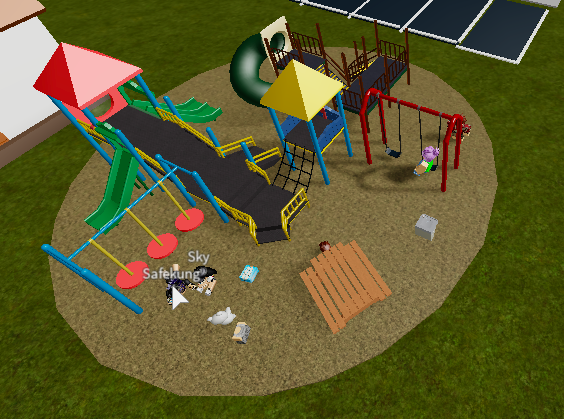
Vacant Lot 4 → Playground
A new playground achieves SDG 11.7 by providing accessible access of a "third place" (a place besides home and school) to children in South Chicago.
There is one playground in Bessemer Park for the 7,446 kids living in South Chicago. In comparison, Lincoln Park, a very wealthy neighborhood, has seven playgrounds for only 2,304 children. I want to add another playground in this area of South Chicago because the ratios between these neighborhoods are off. It is not fair for children to not have reachable playgrounds to have fun at after school in South Chicago, while there is an outrageous amount in rich neighborhoods for so little amount of kids.
A new playground achieves SDG 11.7 by providing accessible access of a "third place" (a place besides home and school) to children in South Chicago.
There is one playground in Bessemer Park for the 7,446 kids living in South Chicago. In comparison, Lincoln Park, a very wealthy neighborhood, has seven playgrounds for only 2,304 children. I want to add another playground in this area of South Chicago because the ratios between these neighborhoods are off. It is not fair for children to not have reachable playgrounds to have fun at after school in South Chicago, while there is an outrageous amount in rich neighborhoods for so little amount of kids.
 |
| JMP, Playground, (2019) |
South Chicago (93rd St) Metra Train → Solar Panels
The Metra train releases a lot of pollution in the air. This can affect the residents of this block with different diseases, such as heart disease, diabetes, and cancer. Solar panels can reduce the energy use at the station in an eco-friendly manner.
This new addition reaches SDG 11.6 by "reducing the adverse per capita environmental impact of cities". It keeps a lower risk of disease for minorities living in the area. Solar panels use free energy from the sun to use less money for resources that will run out one day. The air quality would be healthier and cleaner.
The Metra train releases a lot of pollution in the air. This can affect the residents of this block with different diseases, such as heart disease, diabetes, and cancer. Solar panels can reduce the energy use at the station in an eco-friendly manner.
This new addition reaches SDG 11.6 by "reducing the adverse per capita environmental impact of cities". It keeps a lower risk of disease for minorities living in the area. Solar panels use free energy from the sun to use less money for resources that will run out one day. The air quality would be healthier and cleaner.
 |
| JMP, Solar Panels, (2019) |
Water Fountain
Kids get thirsty after playing in the playground or working hard on art in Container City. Free water should be accessible for these kids so they can continue having fun with comfort and health.
Volume of cone: 1/3ft x 𝛑 x 1ft ² x 2 ft= 2.09 ft ^3
Peter Calthorpe's principles for building better cities helped set a goal for my design.
1) Mix: Create mixed-use and mixed-income neighborhoods
The newly designed place has gardeners, children, artists, and commuters conjoining together in one place. The mixed-land use by different people is important for new connections to form and create together.
2) Walk: Design human scale neighborhoods
All of the new attributes in this area are designed for pedestrians and are walkable from one point to another. They are all easy to access by walking along the outside of the buildings. It is enjoyable to walk around in a bustling area with more activities to do than a desolate, vacant place.
3) Focus: Match density and mix to transit capacity
Since there is a lot of people waiting until the Metra gets there, I implemented many activities to do around the station so they would not get bored. It may bring travelers back to spend time in the neighborhood on their own and meet the residents that live around there.
Overall, this has been my most favorite project in Urban Planning. I felt like I can actually make a change in my former neighborhood. I had problems with creating a 3D model of the redesigned place. First, I tried making it by hand with cardboard and glue, but it took a long time for the first step. I decided to switch to Roblox to make the 3D design, which turned out amazing. I also has problems with finding the right area to redesign, but I had conversations with my family about what they thought was vacant in the neighborhood and ideas of improvements.
Citations
“Age and Sex in Lincoln Park, Chicago, Illinois (Neighborhood).” The Demographic Statistical Atlas of the United States - Statistical Atlas, statisticalatlas.com/neighborhood/Illinois/Chicago/Lincoln-Park/Age-and-Sex.
Kids get thirsty after playing in the playground or working hard on art in Container City. Free water should be accessible for these kids so they can continue having fun with comfort and health.
Volume of cone: 1/3ft x 𝛑 x 1ft ² x 2 ft= 2.09 ft ^3
 |
| JMP, Water Fountain, (2019) |
1) Mix: Create mixed-use and mixed-income neighborhoods
The newly designed place has gardeners, children, artists, and commuters conjoining together in one place. The mixed-land use by different people is important for new connections to form and create together.
2) Walk: Design human scale neighborhoods
All of the new attributes in this area are designed for pedestrians and are walkable from one point to another. They are all easy to access by walking along the outside of the buildings. It is enjoyable to walk around in a bustling area with more activities to do than a desolate, vacant place.
3) Focus: Match density and mix to transit capacity
Since there is a lot of people waiting until the Metra gets there, I implemented many activities to do around the station so they would not get bored. It may bring travelers back to spend time in the neighborhood on their own and meet the residents that live around there.
Overall, this has been my most favorite project in Urban Planning. I felt like I can actually make a change in my former neighborhood. I had problems with creating a 3D model of the redesigned place. First, I tried making it by hand with cardboard and glue, but it took a long time for the first step. I decided to switch to Roblox to make the 3D design, which turned out amazing. I also has problems with finding the right area to redesign, but I had conversations with my family about what they thought was vacant in the neighborhood and ideas of improvements.
Citations
“Age and Sex in Lincoln Park, Chicago, Illinois (Neighborhood).” The Demographic Statistical Atlas of the United States - Statistical Atlas, statisticalatlas.com/neighborhood/Illinois/Chicago/Lincoln-Park/Age-and-Sex.
“School Enrollment in South Chicago, Chicago, Illinois (Neighborhood).” The Demographic Statistical Atlas of the United States - Statistical Atlas, statisticalatlas.com/neighborhood/Illinois/Chicago/South-Chicago/School-Enrollment.
“What Is Project 24?” Project 24 NI | Transforming a Derelict Location, project24ni.com/about/.
“What Is Project 24?” Project 24 NI | Transforming a Derelict Location, project24ni.com/about/.


