Looking for Something?

Showing posts with label Fall 2017. Show all posts

Friday, October 27, 2017

Hero's Journey

In the last unit called “Journeys” in our Stories class, we learned about what makes up a hero’s journey. We created slides to analyze 2 hero’s; a fictional and a real hero. It was a bit hard to decide on what heroes to choose, but I have always loved the movie Wall-E, so I thought I could write about it pretty easily. I watched the movie again to refresh my thoughts, and wrote down elements that made Wall-E a hero. I never analyzed a movie that intense before, so I noticed a lot of new innuendos and jokes that I never caught as a child. I liked learning about the components of a journey and compare it to other stories. An adventure really shapes a character into a better, more confident version of themselves. I feel confident in writing stories with meaning and with characters with a purpose.

The two heroes that we chose were Wall-E and Abraham Lincoln. Wall-E is the fictional hero and Lincoln is the real life hero. I also chose Abraham Lincoln because he doesn't relate to Wall-E in a physical sense; he is a real life human being. We are familiar with Lincoln as him being our 16th president, but he is also a hero for saving slaves from imprisonment for no good reason. I chose Wall-E because he is an awkward, lonely, curious robot that wants to find purpose in the world. He is very determined to hold hands and fall in love with a robot that visited Earth, named Eve. Eve took Wall-E's plant away from him and shut down. He gained a lot of courage from going after the plant and Eve. We also studied Abraham Lincoln, which went through a lot of ridicule and fights to ban slavery. He died for fighting for what is right. Wall-E almost died, but Eve saved him. They both faced fear, trials, mean characters, sad situations. They both won a battle that they didn't think they would win.

I have a slideshow that follows Lincoln's and Wall-E's adventure.

Monday, October 16, 2017

4 Degrees of Death for African Penguins

Scott, Mike. African Penguin Laying on an Egg, (2008)
In my STEAM class "Population", we learned about the evolution of organisms on Earth. We got to go to the Field Museum to study our animal up close. We learned different math concepts, such as a Box and Whisker Plot, standard deviation, standard deviation, permutation, and combination.

Our challenge was to take an element of our animal's life and change it. My animal is the African penguin, which lives in the Southern tip of Africa, along the coast of the Southern ocean. Their climate is humid and sunny. In my scenario, African penguins still live in South Africa, but the temperature raises by 4 degrees. 4 degrees average may seem like a little bit, but it places a lot of weight on the penguin life. If you think that 4 degrees is a little bit, think again. The average temperature during the Ice Age rose by 4 degrees. That new temperature is the temperature that we live in today! Snowy ice caps everywhere disappeared. Hot weather for the penguins got even hotter, so they are placed in a bad spot.


The African Penguin would suffer from 3 risks in the hotter weather; heat waves, rain storms that lead to high sea levels, and eggs not properly warmed up. The opportunities are that they don't have to grow as many feathers to keep warm, so they can get around faster with a slimmer body. I looked at 9 penguins, and took a sample set of how fast they swim.

I figured out the minimum, maximum, range, mean, median, mode, first quartile, third quartile, and the range of those quartiles. I made a box and whisker plot to depict how the data is distributed. The plot is pretty much in a good range.

JMP, Data, (2017)
I took the data and subtracted the arithmetic mean from them. I took that mean and square it, and added all the numbers together. Then I divided it by the number of data minus 1, to get a sample number. I took the total (18.99) and i found the square root of it, which is 4.35. That is my standard deviation, which is a quantity calculated to indicate the extent of deviation for a group as a whole.

We learned about how to figure out the different ways you can choose a number of objects out of a group. When order matters, it is called permutation. When order doesn't matter, it's called combination. 

Since there are 9 different penguins, and I'm choosing 3, my combination will look like 9C3.

Permutation will not work for this situation.

JMP, Order, (2017)
This is a combination because I chose the penguins at random.

Tuesday, September 19, 2017

Waddling the Way


RCCKR, African Penguin, (2015)
In my STEAM class Population, we are learning about living things and how they are classified. We learned about how organisms are grouped by many different ways, such as if they make their own energy, how many cell(s) they have, their binomial nomenclature, physical traits, and behavioral traits. Living things are then placed in a taxonomic system based on those traits. The different levels of the taxonomic system are kingdom, phylum, class, order, family, genus, and then species. We also learned about Set Theory, which is the mathematical language of grouping figures. This helps us compare and contrast different sets with each other in an easy and simple way to read.
For this project, I had to learn in depth about African Penguins and see where they are classified in the taxonomic system. The class and I went to Lincoln Park Zoo to study our animals up close.They were very friendly and happy! African penguins are the only species in their genus, meaning that they are not very related to other animals.They enjoy being moist and swimming in water. They can swim up to 22 miles per hour! Their meals consist of sardines and other small fish. They are usually very friendly animals, unless another penguin tries to take its food. They are only native to south-western Africa. Their species is the only species of penguins in Africa. There are about 141,000 African penguins left in the world, which means that they are classified as an endangered animal.
    JMP, African Penguin, (2017)
This chart shows the African Penguin’s place in the taxonomic system, and proof that they belong in a specific group. 
TAXONOMY LEVEL
CLASSIFICATION OF AFRICAN PENGUIN
PHYSICAL DESCRIPTION OF THIS CLASSIFICATION
Kingdom
Animalia
Multicellular, heterotrophic,
Phylum
Chordata
Spinal chord, tail
Class
Aves
Feathers, lay eggs, warm-blooded
Orde
Sphenisciformes
Aquatic flightless birds
Family
Spheniscidae
Webbed feet
Genus
Spheniscus
Black and white, lives in South Africa, loves sandy beaches
Species
demersus
Eats fish,  has two flippers, waddles

I made a Venn diagram comparing and contrasting the African Penguin, Black Ant, and Fennec Fox. They all cant fly, have at least two legs, heterotrophs, sexual, and walk around in groups. The african penguin in the only one that swims, eats fish, beaked, and has wings. Both the african penguin and the black ant have kings and queens in their groups. Both the african penguin and the fennec fox have fur and live in a hot habitat. The only thing that the black ant and the fennec fox had alike was that they are both omnivores. The ant has a stinger, is harmless, and is part of the insecta category. The fox has claws that is good for catching prey.
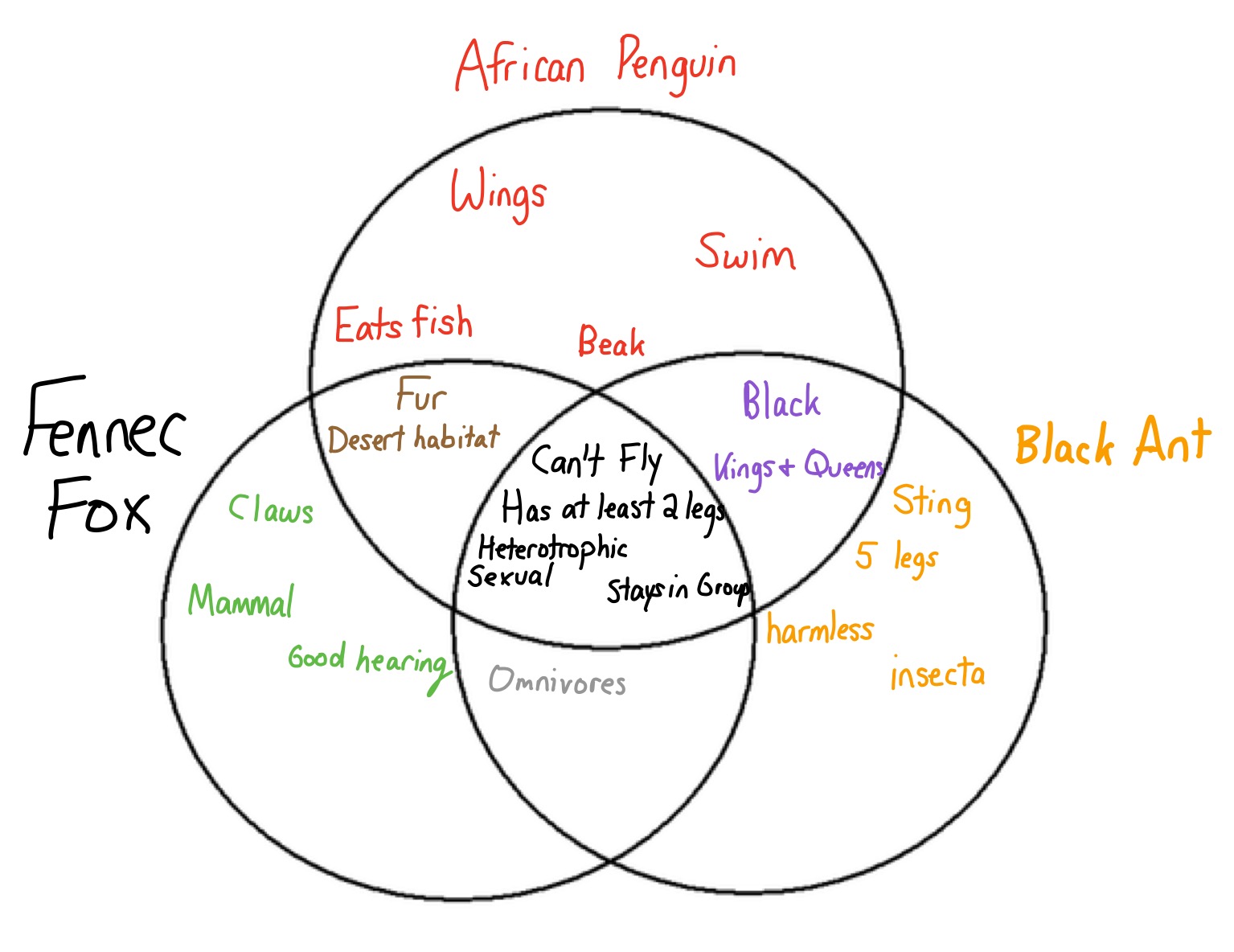
FullSizeRender (2).jpg
JMP. (2017) Venn Diagram.
In class, we learned a new mathematical language to describe what things are in sets. This is called set theory. I used this language to describe African Penguins.

U= (wings, eyes, fur, claws, swims)
P= (traits of a penguin)
F= ( traits of a fox)

P=(wings, eyes, fur, swims)
F=(eyes, fur, claws)

wings ∈ P
Wings are an element of a penguin’s traits.

claws ∉ P
Claws are not an element of a penguin.

P ⋂ F = (wings, eyes, fur)
Both penguins and foxes have wings, eyes, and fur.

P ∪ F = (wings, eyes, fur, claws, swims)
Either penguins or foxes have wings, eyes, fur, claws, or swim.

P’ = (claws)

I thought that studying the African Penguin up close was super cool. Discovering where it belongs in the taxonomic system was pretty straightforward and easy. It was easier than I thought it would be since I set up a schedule on finishing my work on time.

One Fish, Two Fish, Red Fish, Dead Fish

In my last term for my STEAM class, I took a course called Frontiers. This term was the first ever time that course was introduced to GCE L...

Popular Posts