Showing posts with label STEAM. Show all posts
Showing posts with label STEAM. Show all posts
Saturday, June 13, 2020
One Fish, Two Fish, Red Fish, Dead Fish

Tuesday, March 17, 2020
Don't Be Self Conchas
I never would have thought that I would want to be a social entrepreneur, ever in my life. I grew up thinking that working for a business only meant that you would have to be stuck in a suit and tie, running from meeting to meeting through downtown's many buildings, on a 9am-5pm schedule. I was very stubborn in my first days of my Social Entrepreneurship & You course because I was not particularly interested about that side of business. However, my perception of business changed when I gave this course a chance. I was surprised to discover through class discussion that...
Business is everywhere.
Business is the tamale lady standing on the corner, hustling to sell more than her competitor across the street.
Business is negotiating the price of a house you want to buy off of a seller.
Business is trading your bag of chips for a classmate's stack of Oreos.
We partake in business everywhere we go, though we don't realize it. Though I was fascinated by that idea, I was more intrigued that business can be used for social good, aka social entrepreneurship. I learned about key concepts of social entrepreneurship, identifying social issues, different types of investors, and how to create a business plan.
I've been in charge of my own jewelry business since last April. I haven't had the chance to sit down and create a detailed business plan about it, so I took advantage of the time given to do this Action Project to focus on my business.
It was very difficult to delve into my business and nitpick something I am very passionate about, and discover why I am so passionate about it. I am beyond proud of my finished work. I hope I am able to find an angel investor soon to take my business to the next level, thanks to taking this class.
Ali, Tanveer. “Hispanics Pass Blacks As Chicago's 2nd Largest Racial, Ethnic Group: Census.” DNAinfo Chicago, DNAinfo Chicago, 15 Sept. 2017, www.dnainfo.com/chicago/20170914/near-west-side/census-white-black-hispanic-majority-minority-race-ethnicity-population-change-2016-2017-decline/.
Bloom, Mina. “City's Latino Neighborhoods: Population Up, Challenges Persist, Report Says.” DNAinfo Chicago, DNAinfo Chicago, 13 Oct. 2017, www.dnainfo.com/chicago/20171011/logan-square/uic-report-latino-neighborhoods-report-latino-population-growth-chicago/.
Duncan, Eric. “Topic: Jewelry Market Worldwide.” Www.statista.com, www.statista.com/topics/5163/jewelry-market-worldwide/.
Saturday, November 16, 2019
Promoting Success with Access
The senior class took hold of the steering wheel for the second half of our Economics course. The focus of the course was on the book “Doughnut Economics” by Kate Raworth. In her book, she visits the idea of old economic theory and renovates it in a more modern way of thinking. My class of 14 students was divided into groups of two. Each group focused on a chapter in “Doughnut Economics” and had to teach a lesson based on the chapter. My friend JN and I’s chapter, “Create to Regenerate”, was about the difference between a circular economy and linear economy. JN and I wanted to make our lesson interactive (aka not showing a wordy slideshow) so we had the class participate in a simulation. The simulation went as planned, with some minor discrepancies. Once the class and the teacher reflected on what they learned from our simulation, JN and I felt very accomplished of our successful lesson! It was very cool to hear other student’s presentations and views on the other chapters of “Doughnut Economics”. After studying Raworth’s book, the senior class went downtown to WeWork to visit a company named Rheaply. Instead of creating new, why not create a community of companies willing to reduce the amount of garbage at landfills? Rheaply aims to create a circular economy with creating an accessible, sustainable market for companies to sell and buy old resources. Rheaply was started by a young, black man, which is really inspiring to see a person of color as the CEO of a company. I gained a lot of valuable knowledge from this Field Experience.
To wrap the end of this term, I have created a mock chapter for “Doughnut Economics”. In this project, I will introduce another way to think like a 21st century economist.
Raworth says in “Doughnut Economics”,“Economics is not a matter of discovering laws: it is essentially a question of design.” We must fight the status quo right now and bring more representation in businesses for younger generations of people of color. Markets are not the most accessible right now, but young POC are working on it. Personally, I am fighting my own battle in the market world. I am a Latina, first generation, low-income queer woman that has started a jewelry business this past summer. I sell clay earrings based off of Mexican sweet treats. Since there are no spaces in the Southeast side of Chicago to sell my art to my intended audience (Hispanic/Latinx people), I travel two hours to the northside of Chicago to sell my jewelry at pop up shops. Since majority of buyers in the northside are not familiar with Mexican culture, I often have to teach about my heritage while trying to sell items. Trying to validate and educate my culture to anglo people as a Mexican teen is tough, so I usually do not get very far. The result? Traveling back two hours to the Southeast side with a backpack still full of jewelry. The market is not accessible to me or Latinx buyers. We both don’t benefit from this situation. I don’t sell jewelry to Latinx people, and the Latinx people are not able to buy my art at a location by them. According to Fortune, seventy-three percent of the senior executives, men and women, are white. The rest are 21% Asian, 3% Latino/a, 2% black, 0.6% two or more races, 0.2% Native American and 0.1% Native Hawaiian or Pacific Islander. Since this is the case, I was very surprised to see a black man as the CEO of the company we visited for our Field Experience. Gary Cooper, CEO of Rheaply, said ,“Starting a company is really really hard. Starting a company in tech, as a first time founder, is three more times as hard. Not a lot of founders are minorities, less than 1%. So there’s a lot of things that are hard to navigate. I think the hardest thing is taking the leap. To just say, hey, I believe in this, I think it could work.” I think Gary understands the struggle as much as I do, but we still both took the leap to start our business with great confidence. Once the market world is more accessible to minorities, people like Gary and I could thrive and sell more to our intended audiences, and benefit those who are looking for our services
Citations
Jones, Stacy. “Fortune 500: 7 in 10 Senior Executives Are White Men.” Fortune, Fortune, 10 June 2017, fortune.com/2017/06/09/white-men-senior-executives-fortune-500-companies-diversity-data/.
To wrap the end of this term, I have created a mock chapter for “Doughnut Economics”. In this project, I will introduce another way to think like a 21st century economist.
Promoting Success with Access
 |
| JMP, Promoting Success with Access, (2019) |
As I conduct a tour throughout the halls of the Art Institute of Chicago with my black and brown friends, unwelcoming stares from white tourist families burn. Black security guards stand at their post with blank faces, ignored by visitors left and right. When I leave late from work, I see older hispanic women cleaning up after fancy events held for the rich. 7 in 10 senior executives in the Fortune 500 are white men. Seeing a person of color be a senior executive in a large company is unusual. This system is still around because it is harder for minorities, first generation, women, and low-income people to earn high education and have their voice heard. It is a major problem in our current world that people of color (POC) are not represented right in our economy. Imagine what the future COULD look like. If it wasn’t unusual to see a black woman as CEO of a company, younger black kids would look up to her and be inspired by simply seeing someone that looks like them in power. If the economy provided a space for Latino sellers in desert neighborhoods, neighbors would come out and create stronger community. This sort of global perspective benefits both parties through cultural capital. Cultural capital would give power to people of color in the market and become successful and rise up the social ladder without necessarily having financial capital. Every market should exist once the economic world is more accessible for minorities.
Raworth says in “Doughnut Economics”,“Economics is not a matter of discovering laws: it is essentially a question of design.” We must fight the status quo right now and bring more representation in businesses for younger generations of people of color. Markets are not the most accessible right now, but young POC are working on it. Personally, I am fighting my own battle in the market world. I am a Latina, first generation, low-income queer woman that has started a jewelry business this past summer. I sell clay earrings based off of Mexican sweet treats. Since there are no spaces in the Southeast side of Chicago to sell my art to my intended audience (Hispanic/Latinx people), I travel two hours to the northside of Chicago to sell my jewelry at pop up shops. Since majority of buyers in the northside are not familiar with Mexican culture, I often have to teach about my heritage while trying to sell items. Trying to validate and educate my culture to anglo people as a Mexican teen is tough, so I usually do not get very far. The result? Traveling back two hours to the Southeast side with a backpack still full of jewelry. The market is not accessible to me or Latinx buyers. We both don’t benefit from this situation. I don’t sell jewelry to Latinx people, and the Latinx people are not able to buy my art at a location by them. According to Fortune, seventy-three percent of the senior executives, men and women, are white. The rest are 21% Asian, 3% Latino/a, 2% black, 0.6% two or more races, 0.2% Native American and 0.1% Native Hawaiian or Pacific Islander. Since this is the case, I was very surprised to see a black man as the CEO of the company we visited for our Field Experience. Gary Cooper, CEO of Rheaply, said ,“Starting a company is really really hard. Starting a company in tech, as a first time founder, is three more times as hard. Not a lot of founders are minorities, less than 1%. So there’s a lot of things that are hard to navigate. I think the hardest thing is taking the leap. To just say, hey, I believe in this, I think it could work.” I think Gary understands the struggle as much as I do, but we still both took the leap to start our business with great confidence. Once the market world is more accessible to minorities, people like Gary and I could thrive and sell more to our intended audiences, and benefit those who are looking for our services
Citations
Jones, Stacy. “Fortune 500: 7 in 10 Senior Executives Are White Men.” Fortune, Fortune, 10 June 2017, fortune.com/2017/06/09/white-men-senior-executives-fortune-500-companies-diversity-data/.
Raworth, Kate. Doughnut Economics: Seven Ways to Think like a 21st-Century Economist. Random House Business Books, 2018.
Friday, October 18, 2019
Curating My Future Life Choices
 |
| JMP, Lifetime Earnings of a Museum Curator, (2019) |
1. What is your career?
"My job encompasses planning, implementing and supporting our programs for family audiences which include everyday, seasonal and annual programming, such as our festivals and some offsite programming. I am also a manager of teen programs here in our division and department, where I mentor the teens in our internships here at the museum."
2. What college did you attend? Why did you decide to go to college? Why did you decide to attend your college?
"I decided to go to college, because really it was the only way I had ever been taught that I could sustain a life for myself as an independent woman. My mom was the person in my family that really pushed me to obtain a higher education and to always do well in school. In the fall of 2011, I attended Virginia Commonwealth University (VCU), in Richmond, Virginia where I would graduate with a Bachelors of Science degree in Anthropology and African American Studies. I decided to go there, because I liked the environment of the school. Mostly I felt as if I could see myself there and indulge in the culture of the university and of the city. The school also had the major I was considering initially, which was journalism. I also liked that Richmond wasn’t too far from home, but I got to have a sense of newness by going to college out of state since I’m from North Carolina."
3. Was college a worthwhile time and money investment for you? Does your career right now make up for the investment during college?
"College was worthwhile of my time, because I felt that I experienced so many new things, learned so much about myself and how to critically think about the world, especially as a black person and woman living in the United States. I met so many new people and built amazing connections. I have to say that besides receiving a full scholarship during graduate school, the money I invested in my undergraduate degree at VCU was not worth the debt I would take on considering that the career I am currently in does not pay enough to maintain a comfortable standard of living in Chicago and allow me to pay my student loans without sacrifice. I like what I do, but I don’t think that a passion for something makes up for being underpaid. The field of education is highly undervalued in terms of the hard work that we do and how it is decided how much that is worth in terms of salary and wages."
4. What advice do you have for me on the value of my college education?
"The advice I would offer to you Jessenia, is to follow your heart and make good decisions in the moment. Always know that there are so many possibilities to the way you can achieve what you want. Know that while your education is important, it does not solely make up who you are or say everything about your worth as a person. Who you are is not about what you do, it is about the content of your character. And if you lead yourself into your college experience being sure about that, what you want and advocating for yourself first, you cannot go wrong."
Tuesday, June 4, 2019
Rebuilding a Better Chicago
Since many of my summer programs as a tween were in downtown Chicago, I had to learn how to navigate the city by myself at an early age. Getting lost was my worst nightmare. Slowly after taking the time to explore the city on Google Maps on late summer nights, my love for the design of the city grew. I was able to share my good and bad experiences in the city in my last unit of my class "Urban Planning." It was interesting to go back in Chicago's history and learn about how the planned growth of the grid system came to be. I found it helpful to think of different solutions to the many problems that arise in Chicago, instead of spending time listing out the faults of the past. We focused on the Industrial Revolution and how it played a part in cities all across the world, redlining, eminent domain, and unique ideas on how to revolutionize the future of urban planning. Our last FE of the year consisted of taking a tour of the pedway system in downtown. I was amazed to discover that I can travel in the city by foot without needing to go outside. We took our research to the test by redesigning one area of a city with inspiration from cities and spaces around the world, the SDG targets, data of the area, and a TED talk speaker named Peter Calthorpe.
I chose to redesign a block in the South Chicago neighborhood because that is where I grew up. I often took the South Chicago (93rd) Metra train to go downtown as a kid. The space has always made me jittery while I waited for the train because it is very deserted and is not cared for by the city. Vacant lots surround the bustling station. The kids that live on the block do not spend time outside because the space is not very kid friendly. I think that every family should feel the comfort of being able to spend time around their block while having fun on their free time.
The area of the redesigned space is 404ft (Baltimore Ave to Brandon Ave) x 528ft (E 93rd St to E 92nd St) = 213,312 ft²
I replaced four of the vacant lots with new structures for the community and made the transportation there more eco-friendly.
You can play in my newly designed block of South Chicago in Roblox by clicking here.
Vacant Lot 1 → Container City
I was heavily inspired by Project 24 in the city of Bangor for this design. They used old shipping containers and repurposed them into art spaces for the community that are open 24 hours everyday. There are not a lot of "third places", or places for families besides home and work/school in South Chicago. I have artsy friends in the neighborhood but we are discouraged that there isn't a clean place to do art freely outside. There are unused shipping containers in Vacant Lot 1, so I think Project 24's idea could be recreated there.
Vacant Lot 2 → Community Garden
Community gardens promote relationship building, cheaper food transportation costs, and reduces water runoff. Philadelphia has about 470 community gardens all over the city. They have specfifc permits allowing urban farmers to own lands for food for the community. That inspired me to create one in a community that need it a lot. There is usually flooding of water in Vacant Lot 2, so I believe that the water could be used for a good cause. According to Chuy Silva, resident of South Chicago, he sees a lot of hungry homeless people hanging around local grocery stores begging for food. He believes that a community garden can help assist those homeless people so they can have food to eat.
I chose to redesign a block in the South Chicago neighborhood because that is where I grew up. I often took the South Chicago (93rd) Metra train to go downtown as a kid. The space has always made me jittery while I waited for the train because it is very deserted and is not cared for by the city. Vacant lots surround the bustling station. The kids that live on the block do not spend time outside because the space is not very kid friendly. I think that every family should feel the comfort of being able to spend time around their block while having fun on their free time.
The area of the redesigned space is 404ft (Baltimore Ave to Brandon Ave) x 528ft (E 93rd St to E 92nd St) = 213,312 ft²
I replaced four of the vacant lots with new structures for the community and made the transportation there more eco-friendly.
 |
| JMP, Current Space, (2019) |
 |
| JMP, Redesigned Space, (2019) |
Vacant Lot 1 → Container City
I was heavily inspired by Project 24 in the city of Bangor for this design. They used old shipping containers and repurposed them into art spaces for the community that are open 24 hours everyday. There are not a lot of "third places", or places for families besides home and work/school in South Chicago. I have artsy friends in the neighborhood but we are discouraged that there isn't a clean place to do art freely outside. There are unused shipping containers in Vacant Lot 1, so I think Project 24's idea could be recreated there.
 |
| JMP, Container City, (2019) |
 |
| JMP, Inside Art Container, (2019) |
 |
| Project 24, Untitled, (2019) |
Community gardens promote relationship building, cheaper food transportation costs, and reduces water runoff. Philadelphia has about 470 community gardens all over the city. They have specfifc permits allowing urban farmers to own lands for food for the community. That inspired me to create one in a community that need it a lot. There is usually flooding of water in Vacant Lot 2, so I believe that the water could be used for a good cause. According to Chuy Silva, resident of South Chicago, he sees a lot of hungry homeless people hanging around local grocery stores begging for food. He believes that a community garden can help assist those homeless people so they can have food to eat.
 |
| JMP, Community Garden, (2019) |
Vacant Lot 3 → Coffee Shop
This block does not have any shops to buy food or drink. Commuters have to go out of their way to get breakfast, lunch, or dinner. It would be easier for Metra riders to fill their stomachs before going to school or work if there was a shop around. A coffee shop will benefit residents on the block and hungry pedestrians.
Volume of Coffee Shop building: Rectangular pyramid: 1/3 ft x 30 ft(L) x 50ft (H) x 25ft (W)= 12,500ft^3
 |
| JMP, Coffee Shop, (2019) |
Vacant Lot 4 → Playground
A new playground achieves SDG 11.7 by providing accessible access of a "third place" (a place besides home and school) to children in South Chicago.
There is one playground in Bessemer Park for the 7,446 kids living in South Chicago. In comparison, Lincoln Park, a very wealthy neighborhood, has seven playgrounds for only 2,304 children. I want to add another playground in this area of South Chicago because the ratios between these neighborhoods are off. It is not fair for children to not have reachable playgrounds to have fun at after school in South Chicago, while there is an outrageous amount in rich neighborhoods for so little amount of kids.
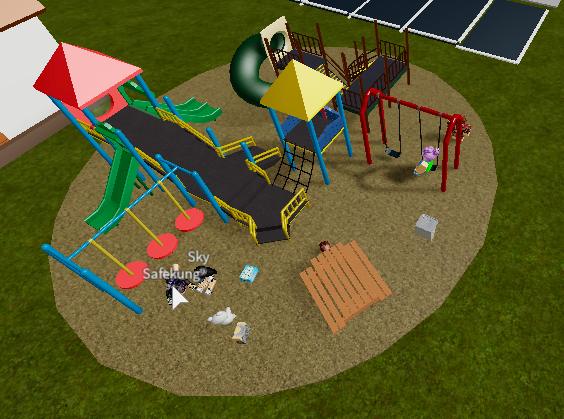 |
| JMP, Playground, (2019) |
South Chicago (93rd St) Metra Train → Solar Panels
The Metra train releases a lot of pollution in the air. This can affect the residents of this block with different diseases, such as heart disease, diabetes, and cancer. Solar panels can reduce the energy use at the station in an eco-friendly manner.
This new addition reaches SDG 11.6 by "reducing the adverse per capita environmental impact of cities". It keeps a lower risk of disease for minorities living in the area. Solar panels use free energy from the sun to use less money for resources that will run out one day. The air quality would be healthier and cleaner.
 |
| JMP, Solar Panels, (2019) |
Water Fountain
Kids get thirsty after playing in the playground or working hard on art in Container City. Free water should be accessible for these kids so they can continue having fun with comfort and health.
Volume of cone: 1/3ft x 𝛑 x 1ft ² x 2 ft= 2.09 ft ^3
Peter Calthorpe's principles for building better cities helped set a goal for my design.
1) Mix: Create mixed-use and mixed-income neighborhoods
The newly designed place has gardeners, children, artists, and commuters conjoining together in one place. The mixed-land use by different people is important for new connections to form and create together.
2) Walk: Design human scale neighborhoods
All of the new attributes in this area are designed for pedestrians and are walkable from one point to another. They are all easy to access by walking along the outside of the buildings. It is enjoyable to walk around in a bustling area with more activities to do than a desolate, vacant place.
3) Focus: Match density and mix to transit capacity
Since there is a lot of people waiting until the Metra gets there, I implemented many activities to do around the station so they would not get bored. It may bring travelers back to spend time in the neighborhood on their own and meet the residents that live around there.
Overall, this has been my most favorite project in Urban Planning. I felt like I can actually make a change in my former neighborhood. I had problems with creating a 3D model of the redesigned place. First, I tried making it by hand with cardboard and glue, but it took a long time for the first step. I decided to switch to Roblox to make the 3D design, which turned out amazing. I also has problems with finding the right area to redesign, but I had conversations with my family about what they thought was vacant in the neighborhood and ideas of improvements.
Citations
“Age and Sex in Lincoln Park, Chicago, Illinois (Neighborhood).” The Demographic Statistical Atlas of the United States - Statistical Atlas, statisticalatlas.com/neighborhood/Illinois/Chicago/Lincoln-Park/Age-and-Sex.
Kids get thirsty after playing in the playground or working hard on art in Container City. Free water should be accessible for these kids so they can continue having fun with comfort and health.
Volume of cone: 1/3ft x 𝛑 x 1ft ² x 2 ft= 2.09 ft ^3
 |
| JMP, Water Fountain, (2019) |
1) Mix: Create mixed-use and mixed-income neighborhoods
The newly designed place has gardeners, children, artists, and commuters conjoining together in one place. The mixed-land use by different people is important for new connections to form and create together.
2) Walk: Design human scale neighborhoods
All of the new attributes in this area are designed for pedestrians and are walkable from one point to another. They are all easy to access by walking along the outside of the buildings. It is enjoyable to walk around in a bustling area with more activities to do than a desolate, vacant place.
3) Focus: Match density and mix to transit capacity
Since there is a lot of people waiting until the Metra gets there, I implemented many activities to do around the station so they would not get bored. It may bring travelers back to spend time in the neighborhood on their own and meet the residents that live around there.
Overall, this has been my most favorite project in Urban Planning. I felt like I can actually make a change in my former neighborhood. I had problems with creating a 3D model of the redesigned place. First, I tried making it by hand with cardboard and glue, but it took a long time for the first step. I decided to switch to Roblox to make the 3D design, which turned out amazing. I also has problems with finding the right area to redesign, but I had conversations with my family about what they thought was vacant in the neighborhood and ideas of improvements.
Citations
“Age and Sex in Lincoln Park, Chicago, Illinois (Neighborhood).” The Demographic Statistical Atlas of the United States - Statistical Atlas, statisticalatlas.com/neighborhood/Illinois/Chicago/Lincoln-Park/Age-and-Sex.
“School Enrollment in South Chicago, Chicago, Illinois (Neighborhood).” The Demographic Statistical Atlas of the United States - Statistical Atlas, statisticalatlas.com/neighborhood/Illinois/Chicago/South-Chicago/School-Enrollment.
“What Is Project 24?” Project 24 NI | Transforming a Derelict Location, project24ni.com/about/.
“What Is Project 24?” Project 24 NI | Transforming a Derelict Location, project24ni.com/about/.
Wednesday, May 15, 2019
Save Our Energy, Save our Planet
Thursday, April 25, 2019
Popsicle Sticks and Glue May Break Ya Bones
We started off our first unit of "Urban Planning" with learning about different kinds of bridges and what their strengths and weaknesses are. I spent a lot of time researching bridges around the city. This class has made me more aware of the structures and bridges I pass by when I am on my way home from school. For the first Action Project, my partner, RP, and I had to create a truss bridge that can support a minimum of ten pounds. From my research, I learned that triangles are the strongest supporting shape in structure, so I wanted to incorporate many triangles into the design. RP and I decided to build a tall, skinny bridge because we wanted to have a challenge. At first we spent a lot of time researching examples of other truss bridges, but our teacher insisted for us to start building as soon as possible because of the tight timeframe we had.
We were heavily inspired by the Chicago Skyway Bridge. The designers of that bridge used many triangles along the mile long structure, so we wanted to use their design in a miniature way.
It was easy to create the sides of our bridge, but we got frustrated on how to connect the two sides together. We used books to keep the bridge glued in place without having to be held up by us. The two sides were connected with 10 popsicle sticks cut in half, to equal 20 mini sticks.
 |
| Bridge Hunter, Untitled, (2019) |
It was easy to create the sides of our bridge, but we got frustrated on how to connect the two sides together. We used books to keep the bridge glued in place without having to be held up by us. The two sides were connected with 10 popsicle sticks cut in half, to equal 20 mini sticks.
Our bridge supports the Sustainable Development Goal 11: Make cities and human settlements inclusive, safe, resilient and sustainable. Every stick used in the bridge has a purpose in order to make the bridge strong enough for safety. We planned for hours to make the bridge what we envisoned in our minds. The bridge held double the minimum amount of weight, so there is confidence it can hold the ten pounds it is supposed to hold.
 |
| Hiu To, Untitled, (2019) |
We ended up with a symmetrical design with 18 tiny triangles on each side of the bridge.We had low confidence that our bridge would be able to hold the minimum weight of 10 pounds because the bottom had begun to start falling apart from tests. We am very excited to share that our truss bridge ended up to hold 20 pounds! It broke after 25 pounds.
 |
| Hiu To, Untitled, (2019) |
 |
| Hiu To, Untitled, (2019) |
Monday, March 25, 2019
Bing Bada Boom Bing Bong Clock
“History of Timekeeping Devices.” Wikipedia, Wikimedia Foundation, 26 Feb. 2019,
“Church Bell.” Wikipedia, Wikimedia Foundation, 12 Mar. 2019,
Wednesday, March 6, 2019
Simple is Smart
In my second unit of Light, Sound, and Time, my class and I focused on how sound works. Although people don't notice it, sound is always present. Silence can't be acquired because our body constantly makes noise and our environment is always in movement. I think that noise gives humans comfort to give the feeling that they are not alone. I like having background noise around me when I work, or else I would be lost in my thoughts. On the mathematical side of the world of sound, we learned how to use the speed of sound in calculations to find wavelength and frequency. We also did a simulation on how life would be with bad hearing. This unit made me thankful for my good hearing and more considerate to help out people if they can't hear as well.
After learning about how sound waves work and their important impact in our daily lives, the class and I created our own diddley bows to create unique sounds. Diddley bows are one stringed guitars that influenced the development of blues music. They can be made with items lying around the house. I used an old tin can, a plank of wood, three screws, two batteries, and a guitar string to make mine. Everyone used the same length of wood, but different sized guitar strings, cans, and nails. My teacher taught us step by step how to make the diddley bow. I had trouble screwing the screws in that help secure my can and string, but my peers assisted me.
The yellow and green line is the middle of the diddley bow's neck. The other lines signify the four harmonics. A harmonic is a tone produced on the diddley bow by touching the vibrating string at one of the marked lines.
After learning about how sound waves work and their important impact in our daily lives, the class and I created our own diddley bows to create unique sounds. Diddley bows are one stringed guitars that influenced the development of blues music. They can be made with items lying around the house. I used an old tin can, a plank of wood, three screws, two batteries, and a guitar string to make mine. Everyone used the same length of wood, but different sized guitar strings, cans, and nails. My teacher taught us step by step how to make the diddley bow. I had trouble screwing the screws in that help secure my can and string, but my peers assisted me.
 |
| JMP, Diddley Bow, (2019) |
I calculated the wavelength by dividing the string's frequency by the speed of sound. Then, I calculated the four harmonics with the frequency and wavelength.
 |
| JMP, Harmonics, (2019) |
My diddley bow demonstrated many key science principles from our lessons in class. The pitch varies based on the material, tightness, and the length of the string. Amplitude is how tall the wave is, which means it has a high volume. The amplitude depends on the size of my can. My can is the biggest of the class, so I have the highest amplitude; aka the loudest volume to hear my sound. The wavelength is determined by the frequency. If the frequency of my string goes up, the wavelength goes down.
Here is a labeled sketch of my diddley bow.
Here is a labeled sketch of my diddley bow.
 |
| JMP, Diddley Bow Sketch, (2019) |
When I pluck my string, the sound wave travels to the can, where the sound gets amplified. With my slider, I can vary the pitch to make different sounds. I had to make sure that the string was tight so it would make a richer sound when I would pluck it. It was cool to see my classmates’ finished products because we all ended up with different pitches of sound.
Variables that Changed the Sound
- Size of hole in can
- Size of can
- Size of plank of wood
- String material
- How tight string was
- Size of battery
- Where battery was placed
- Where slider was moving
I calculated the angles, sides, and area of the space between the nut and resonator. I also calculated the volume of the resonator, because I wanted to know how the amount of space in there affects the sound.
 |
| JMP, Calculations, (2019) |
In conclusion, this unit has taught me a lot. It made me conscious of my surroundings and take the moment in. I have been spending less time on social media and more time admiring the sounds and visuals around me. I would love to make another diddley bow with more strings and with frets so I can tune it. For now, I will practice how to make some music on this first version.
Thursday, February 14, 2019
Pictures Last Forever
What is light?
I never took time to think about this complicated question until my class, “Light, Sound, and Time”, challenged me to answer it. First, we studied the different parts of the human eye and what they do to process images. We compared that process to a camera, which showed that the two have similar procedures! Then, the class and I delved into the science of light. Light is electromagnetic radiation, which can appear as either waves or particles. The range in frequency of the light waves is categorized in the Electromagnetic spectrum. Our eyes can only see the “visible light” portion of the EM spectrum, which are the colors of the rainbow. Other living things, such as the helmet gecko lizard or mantis shrimp, can see different light waves that humans can’t because of how their eye is formed. The science of diverse eyes amazes me, and it makes me wonder what certain colors I see differently than other organisms.
This unit was very interesting to me because it made me realize the science of my everyday life. It felt personal and important to know how my eyes receive light mathematically and scientifically.
For this Action Project, I built a pinhole camera that could successfully take a picture. It was a very tedious procedure. My pinhole camera was constructed from an empty oatmeal container, aluminum, and black paint. I made my lens by poking a pin through the aluminum. Then, I cut a quarter-sized hole into the container for a space for the lens. I made a shutter for the lens too so I can control how long the film gets exposed to light. I painted the inside of the camera black because that color absorbs stray light that doesn’t hit the film. If it was painted white, any other colors, or not painted at all, the photons of light coming from the pinhole would scatter around and overexpose the image.
The Latin School of Chicago generously gave our class a 90 minute photography lesson on how to take pictures with our pinhole cameras and how to develop the film. A red dinosaur was the main focus of my intended photo. I took off the shutter for three minutes and thirty seconds to let the light photons shine only through the pinhole and imprint an image onto the film in the back of my camera.
The light bounced off the top of the dinosaur and hit the paper in a straight line toward the bottom of the film. The light that bounced off the bottom of the dinosaur hit the top of the paper. This projected the image upside down on the film inside the camera.
Here is the image that my pinhole camera took. About 75% of the image appears to be underexposed because there isn’t a figure on it. The other 25% has the checkerboard backdrop and the back of the dinosaur. I think only part of the image was successful because my pinhole was too small and the film was not correctly aligned with the pinhole. I am still proud that I was able to get an image of something.
 |
| JMP, Pinhole Camera (2019) |
 |
| JMP, Lens, (2019) |
 |
| Hiu To, Untitled, (2019) |
 |
| JMP, Pinhole Image, (2019) |
 |
| JMP, Projection of Dinosaur, (2019) |
My camera does not use reflection or refraction to produce an image; as it is an example of light
behaving like a particle because the paper absorbs the light photons. If the light was behaving like a wave, the waves would reflect off the film and would not produce an image. Since the photons stay in air and not another medium while it hits the film, it does not use refraction. It uses visible light from the electromagnetic spectrum in order to produce the image.
Here are my calculations that show the interactions between the light rays, the camera, and the dinosaur.
 |
| JMP. Calculations, (2019)
This STEAM Action Project is now my favorite I have done at GCE. I loved my experience in a dark room in my freshman year at another school, and I always wished to use a dark room again. It felt very accomplishing to create a working camera and get an image. The project felt very connected to the math I calculated. The process was very tedious, but I just spent more time to make sure my work is precise.
|
Friday, January 18, 2019
Climbing Meow Majesties
 |
| KM, Meow Majesties, (2019) |
Bankaroo, a virtual bank for kids, can utilize Meow Mountains by having an interactive, fun lesson on how to budget, save money for goals, and spend money wisely. The jewels in the game can represent real money. Having money may have ups and downs, which is shown through battling other cats, but in the end, the amount of money you have for different wants and needs is dependant on yourself.
At first, the game was going to be about the life as a cat in the city, and by using time management skills, the best scheduled cat would win the game. By letting go of the desired theme and putting more thought into the mechanics and structure of the game, the theme changed according to the rules that were placed. The first playtest made me a little anxious because I felt that the game was not ready. I learned that the point of playtesting was to gather thoughts from outside of team and think about how the game can be improved for the future; that a game wasn’t supposed to be at its final version in the first week. Watching my classmates play the game and have fun without needing any instruction from me or my partners, made us more excited to make the game more user friendly. My partners and I had multiple ideas, but we sat and tested each and every idea and whittled our list down to make the best version possible in the time frame we had. It was interesting to me to see how we were sticking to a 2D game board for the majority of the creation process, but at the last minute we questioned why we put that standard down. We challenged ourselves to make a 3D game board that looks more appealing and nice aesthetic. I was feeling stressed that we would not have a final version by the deadline, but with teamwork and timed goals, we made it happen.
I am very proud of the amount of work I put into the game. I am generally a more creative, artsy person, but I challenged myself to look at the mechanics part of the game. Being able to come up with a player interaction mechanic was hard, and it was critical to think of one up soon or else the game was no fun. By inserting a triggered battle when a player is by another player, made the game more exciting and have more of a luck side instead of being all strategy. After I put that rule in, playtesting got more exciting and had the players on the edge of their seats. I am glad I overcame that challenge, as it helped the flow of the game a lot. I designed the graphics of the board and measured how big each square should be so the layers would fit perfectly, and it came out to look professional and clean. I came up with the idea of using polymer clay to make some of our props, which came out to be handy because it gave the team more use of their imagination to make something what they really wanted. I also wrote the rules and proofread it many times, as clarity and grammar means a lot
Thursday, October 25, 2018
La Cargosian
In our last unit of Design and Engineering, we studied the benefits of using a bicycle. It saves fare or gas money, whizzes past busy traffic, and does not create pollution. We used new Calculus skills to determine the measurements, velocity, acceleration, and distance covered by a bike. We also talked to a representative from Divvy, a bike company in Chicago that rents out bikes. It was awesome to see where the Divvy stations are placed in the city and how the design of their bikes is fit for the average commuter. I never used a Divvy bike before, but after hearing the benefits of using one, I may use one when the weather gets nicer.
For our Action Project, my partner and I designed a bicycle for a certain persona. There are many components when it comes to designing a bicycle. First, we had to research different bicycle designs to see what was out there. Then, we thought about the consumer and what needs they have on the go. After knowing what elements the bike will have, we built a prototype and worked until the final product came along.
I learned that inspiration to design comes from researching existing bikes, but not to let it stop me from expanding those ideas to greater ones.
I interviewed Brent, a teacher at my school. He rides his bike from home to school for ten miles a day. He said…
I am proud that I learned this designing technique and went hands-on to create what my imagination desired. Having empathy and really wanting the best for the consumer is important. I think that this project taught me some life skills, such as planning before acting, thinking outside the box, and connecting my passion of design to the real world.
For our Action Project, my partner and I designed a bicycle for a certain persona. There are many components when it comes to designing a bicycle. First, we had to research different bicycle designs to see what was out there. Then, we thought about the consumer and what needs they have on the go. After knowing what elements the bike will have, we built a prototype and worked until the final product came along.
I learned that inspiration to design comes from researching existing bikes, but not to let it stop me from expanding those ideas to greater ones.
I interviewed Brent, a teacher at my school. He rides his bike from home to school for ten miles a day. He said…
“It has aluminum frame, which transmits a lot of bumps to my body. So any bumps I go over, I feel more than other people with bikes do.”
This inspired my design because I do not want my user to feel bumps easily, especially since she will be traveling on a trail and the street a lot. I researched different materials for the bike frame so it will be the smoothest ride for Malia.
 |
| JMP, Bike Route, (2018) |
Our user is Malia, a fifteen year old girl that lives in Logan Square. She goes to school, works at the library, and buys groceries often. She will use the elevated , hilly 606 bike trail and ride on a bike lane to get to her destinations. She will try her best to be careful riding along intersections with a lot of potholes and debris. She rides home in the dark because of her busy schedule. It will take her about 27 minutes to get to school on her route.
 |
| JMP, La Cargasion, (2018) |
Our new bike design is called “The Cargasion”. Since she will be carrying her schoolbooks and groceries a lot, there is a built in cargo pack in the middle of the bike. The middle of the bike is just empty space on past bikes we have researched, so we wanted to put this space to good use. It is made of a wire net to hold the bags in place, and has a secure cover lock that wraps around, so no one tries to steal her belongings. The saddle is a women's specific saddle so it fits just right. There is a built in metal U-Lock, so she can easily lock the bike securely. It has a foam grip, drop handlebar for 2 sets of brakes and faster speeds since Malia will be leaning forward. The foam grip will keep her sweaty hands stable. The steering will be sensitive so Malia can maneuver on the street. It has 3 sets of gears, since she will be going on some hills. The bike frame is made of titanium, which is a very strong material. The saddle is made to last for comfortable long rides. Malia won’t need to dangerously swerve from potholes and debris, because the tires will be airless- meaning that they never go flat to keep a smooth ride.
I have done the research, measurements, and talked to real bike sellers to make sure I can make the best bike for my person. I made sure that these new implements on the bike make sense and benefit the rider's needs.
I am proud that I learned this designing technique and went hands-on to create what my imagination desired. Having empathy and really wanting the best for the consumer is important. I think that this project taught me some life skills, such as planning before acting, thinking outside the box, and connecting my passion of design to the real world.
Wednesday, September 26, 2018
Culti-Grabbing the Soil
In this unit of Design and Engineering, we learned about how tools are designed, volume, surface area, and vectors, which are important concepts for creating a product. Throughout the class, I was surprised to see that math and drawing had a connection in the real world for designers. We mainly focused on gardening products and how designers must complete many steps before manufacturing a product. For one of our Field Experiences, we had the opportunity to speak with the owner of Beyond Design Inc about the process of inventing an original tool. It made me realize the team effort required to create something that could improve thousands of lives. Mostly elderly people like to garden, though many tools aren’t made for their needs. I learned that it is important to take people’s differences into consideration when designing. For the Action Project, my task was to improve a gardening tool so it makes the task easier for an elderly person. My class and I took a trip to Home Depot to pick a gardening tool and inspect its different components, in order to be inspired for our invention. The tool is meant for someone who has low hand strength, and needs assistance in cultivating the soil for aerated soil. Many tools need a lot of hand strength in order for them to work, but this lightweight hand tool will just need to be lifted and placed on top of the soil so it can do its job. This project is teaching me how to have empathy in designing this tool, because it needs to be made for the hands of someone else, not myself. Empathy is being able to understand how another person feels. I got out of my mindset and was able to interview an avid gardener about how they feel about gardening, so I could think of a solution to their hobby troubles.
JMP, Interview with a Gardener, (2018)
From my interview, I learned that if a designer keeps a tool simple, it will perform amazingly at its intended task. Tools that camouflage with their environment become dangerous, as a gardener might accidentally step on them. Owning brightly colored tools makes them easier to locate. Small tools are popular because they are portable and light. Also, gardeners grow into their hobby because of their parents' or grandparents' love for it. It is a shared passion to enjoy the slow but rewarding growth of plants throughout time.
I had to conduct a lot of research on existing examples of my tool. To cultivate deeper into the soil, a more curved pronged cultivator is best. Keeping it light with minimal prongs will make it more portable. A stronger, three pronged cultivator will aerate the soil best. Cushioned grips make working more comfortable and keeps sweat away. Wood is often used in tools because it is lightweight and is cheap. Not properly using a wood tool can cause breakage.
After gaining a sense of what can be improved in the cultivator, my partner and I created the "Culti-Grab". This new tool acts as an automatic cultivator. The prongs work together to get rid of big clumps of soil so a plant can grow its roots out. It aerates the soil by acting as a claw machine. You hover it over a selected area of clumped soil, and press the GRAB button to dig to break down the lumps. Press the OPEN button to release the claw, to let go of the now aerated soil. The three prongs are made of carbon steel, which is lightweight and strong for the thickest of dirt. A handy timer reminds the gardener to take a break every 30 minutes, to not wear their muscles out. It is recommended to take breaks while gardening, or else strain will cause deep pain in your body. The button makes it simple to adjust the prong’s curl, for different dirt thicknesses. For a comfortable experience, the grip is made of gel that molds to the hand, making the planting feel natural.
This tool gives the gardener a break from intense manual labor, and does the digging for you. Elders can find comfort in the grip, so it doesn’t bruise their hands. Being able to adjust the tool’s parts is handy because it is worth investing in interchangeable tools, rather than tools with different sizes.
The Culti-Grab is similar to a wedge, because it drives into dirt to separate the dirt chunks. The prongs work together to wedge into the soil in order to get the task done. The grab button make the angle of the prongs more drastic so they insert into the soil, and the open button makes the angles of prongs less so the soil can be released.
This project gave me a more positive view of gardening. I recognized that there are many factors in taking part of this hobby. Being able to be hands-on with tools was helpful, because it put me in the shoes of a gardener and the hardships it has. I believe that this hobby is rewarding because you end up with a beautiful piece of life that you helped raise. It was easy for me to depict how to use the new tool. I was able to work well with my partner, by splitting up the work evenly. Coming up with an original idea was difficult at first, but we let our creativity show and thought of the wackiest inventions with no hesitation. If I have the materials one day, I would love to bring this idea to life and use it myself and share it with others!
Thursday, May 31, 2018
Expansionism on Alcoholism
In my last Unit for my STEAM class Cure, we wrapped up what we learned from all units in the Disease and Cure classes. We delved into what it means to prevent a disease or illness. We only had two weeks to get into the unit, so we studied probability of getting a disease and how medicine can change the outcome. We also made a family tree about diseases that run along the generations. I loved learning more about my family and how to prepare myself if I get one of the diseases they had. Our field experience consisted of a Yoga Nindra instructor to help guide the class through a very relaxing meditation. It was my first time meditating, but I had an amazing time. It gave me more energy and made me want to try again. The instructor lead us to the point where you are on the brink of falling asleep, so it’s a very calming state. Meditation can help heal your mind from stress and other worries in the world. I never thought of mind exercises to be helpful, but this field experience changed my mind. Literally.
For this Action Project, we had to create a fictional patient profile. In the profile, we had to write about their lifestyle, behavior, diet, habits, concerns, and family medical history. This resulted in a consultation, in which we had to advise positive changes to their lifestyle, and therapies to help their concerns. I wrote a consultation on someone dealing with alcoholism for ten years. I picked this because I wanted to do an illness, not a disease.
In conclusion, I loved this entire class. I didn’t think I’d be interested in genetic and medical history,
but it really stood out to me. I think that I will take what I learnt in class to the real world, and incorporate it to become more knowledgeable on medical science. I worked really hard on this Action Project to look professional and clean. Hopefully, someone with alcoholism will take my research and advise and take it to their daily life and make better change.
Saturday, May 19, 2018
Reckless Rashes
In my STEAM class named Cure, we learned different ways on how to treat illnessin everyday life. There are three basic ways on how to treat yourself- over the counter drugs, prescriptions, and remedies. I loved learning about the scientific way that drugs work in our body, and how effective it is to our bodies. I only go to the doctor when I am extremely sick, so it was interesting to learn about new home remedies that I can try on myself. Our class performed a lab in which we had a pill that closed off our sour tasting taste buds, so that sour foods tasted sweet. It was a mind blowing experience because I ate hot sauce with ease after I took the pill! And I can’t stand any spicy foods. This lab was to demonstrate how drugs work on our bodies. When you take in a drug, it's molecule fits into it's matching shaped receptor site, just like how a key matches it's lock. Biological events occur within the body, such as chemical reactions or nerve impulses. This mechanism is called "Lock and Key".
For our Action Project, we had to find an illness or symptom that appealed to us and research 3 treatments to make it better. Then, we had to create a medicine box that sold the symptom and its remedies. Each treatment option had its drug facts and instruction on how to do it.
I loved this AP because I am very interested in graphic design and gathering ideas onto an organized platter. I tried very hard to make my box eye catching. Im very proud with the end product and my collected research. I learned useful information that’ll I use in my future!
For our Action Project, we had to find an illness or symptom that appealed to us and research 3 treatments to make it better. Then, we had to create a medicine box that sold the symptom and its remedies. Each treatment option had its drug facts and instruction on how to do it.
 |
| JMP, German Measles, (2018) |
 |
| JMP, Codeine Phosphate, (2018) |
 |
| JMP, Acetaminophen, (2018) |
 |
| JMP, MMR Vaccine, (2018) |
 |
| JMP, Chart, (2018) |
 |
| JMP, Ingredients, (2018) |
Subscribe to:
Posts (Atom)
Popular Posts
-
Life beyond high school is exciting to plan for because I want to live the happiest life possible. I hope to study Anthropology/Sociology a...
-
We have focused on the concept of Time for the last unit of Light, Sound, and Time. I have learned so many new concepts. I was surprised to...
-
It has finally settled in. I spent my last day of senior year of high school for the last time without knowing it. A day that I took for g...


