Looking for Something?

Wednesday, May 22, 2019

Just for the Innocent

We studied the executive branch of government in this unit of Policy. Our class time revolved around the different powers that the President and cabinet members have in government. I went on my own Field Experience to see the mayoral inauguration of Lori Lightfoot, Chicago's first black, female, and openly gay mayor. She is the head of Chicago's smaller scale of an executive branch. All of the new and old aldermen were there to be inaugurated also. I found it energizing to see all of those people in power in the same room and seeing a compassionate group of Chicago residents. I hope to make it to a President's oath of office in my future one day. I think that the mayor has a lot of work to do for the city, but I can't imagine the amount of power the president has over the United States. I find that the power to declare war is a big responsibility. Many wars have been declared in the United States' past. Some wars that we consider to be "real" were not declared by Congress, so the government cannot say those wars were legally entered. The war I decided to study for my Action Project is World War II. I chose this war because I have read non-fiction books of people's perspectives on the Holocaust recently, such as Milkweed by Jerry Spinelli. I had fun researching the history of the war and how it affected the world as a whole, and if it was legal or illegal from the United States' perspective.

Joseph Fornelli, Mission Extraction, Unknown Date
In conclusion, I learned a lot from the process of this Action project. I need to work on being efficient on writing papers and researching. I taught myself how to cite correctly, which is a new and impressive accomplishment. I hope to take the lessons I had from this AP and implement my new research skills on other papers.

Works Cited

Danforth, Bruce. “Why Japan Attacked Pearl Harbor.” Pearl Harbor. Website. https://pearlharbor.org/why-japan-attacked-pearl-harbor/ . Accessed 19 May 2019.

Fornelli, Joseph. "Mission Extraction." National Veterans Art Museum, Chicago. Ink on paper. Accessed 22 May 2019.

Recchiuti, John Louis. “FDR and World War II.” Khan Academy. Website. https://www.khanacademy.org/humanities/us-history/rise-to-world-power/us-wwii/a/fdr-and-world-war-ii . Accessed 19 May 2019.

Roosevelt, Franklin D. “Message to Congress.” 1941. PDF. https://fdrlibrary.org/documents/356632/390886/readingcopy.pdf/42234a77-8127-4015-95af-bcf831db311d . Accessed 19 May 2019.

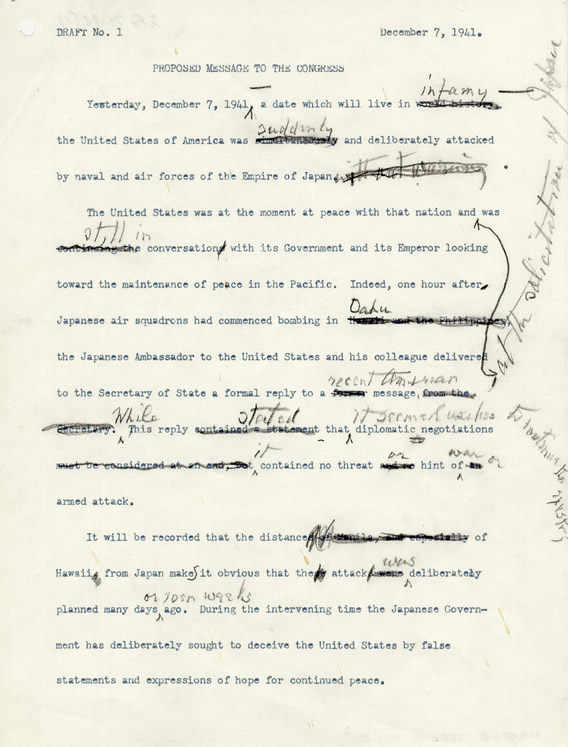
Roosevelt, Franklin D. “Proposed Message to the Congress.” 7 December 1941. PDF File. http://docs.fdrlibrary.marist.edu/images/decwarp1.jpg . Accessed 18 May 2019.

Royde-Smith, John Graham.“World War II.” 23 Aug 1998. Britannica. Website. https://www.britannica.com/event/World-War-II . Accessed 18 May 2019.
United States Constitution. Article I, Section 8, Clause 11. Accessed 20 May 2019.

United States Holocaust Memorial Museum. “Franklin Delano Roosevelt”. Holocaust Encyclopedia. Website. https://encyclopedia.ushmm.org/content/en/article/franklin-delano-roosevelt . Accessed 19 May 2019.

United States Holocaust Memorial Museum. “War Refugee Board: Background and Establishment”. Holocaust Encyclopedia. Website. https://encyclopedia.ushmm.org/content/en/article/war-refugee-board-background-and-establishment Accessed 19 May 2019.

Wednesday, May 15, 2019

Save Our Energy, Save our Planet

 The Power class made me realize that I take electricity for granted. Electricity is one of the most important utilities we use in the city. It connects us to the internet, lights our streets up at night, and powers appliances that make chores easier. Without Tesla and Edison's inventions of AC and DC electricity, we would be stuck in darkness. I learned how to draw a complete circuit diagram with all of the components. The math in this unit interested me because it felt connected to how real electricians understand the amount of voltage, current, and resistance runs through a circuit. For our Field Experience of the unit, the class and I took a trip to the Museum of Science and Industry, one of the last standing buildings of the World's Fair held here in Chicago. We didn't have a chance to visit the Wooden Island, a calm and peaceful area that Frederick Olmsted advocated for. It is one of my favorite places in Chicago to relax and find peace at in the summer.
I was partnered with my classmate PKA to create an energy efficient circuit that is more eco-friendly than our houses in Chicago. It was difficult to create the circuit, but we took our time to create a simple, yet effective one. It was interesting to do the calculations of the voltage, resistance, and current of our circuit because it made our work affirmative. If I had a bigger circuit board, I would like to create a larger circuit with more parallel paths. 

Friday, April 26, 2019

Fair Hours and Fair Pay

In my first unit of "Policy", my class and I have had conversations about policy in history and how it affects the present. We visited newly elected alderman of the 4oth Ward, Andre Vasquez, to talk about his plans for his new role in office. I found it reassuring to hear that he wanted to become alderman because he wants to advocate for his neighbors and their needs to live happy. Since there is a newly elected mayor and many new alderman joining city council, I wonder what Chicago policies will be updated under their rule.

For this Action Project, I am writing to my alderman, Susan Sadlowski Garza, about supporting the Fair WorkWeek ordinance. The Fair WorkWeek ordinance is to give service workers flexible schedules so it works with their day to day life. I am very passionate about equal rights for workers, so I hope takes my letter into consideration. 

Thursday, April 25, 2019

Popsicle Sticks and Glue May Break Ya Bones

We started off our first unit of "Urban Planning" with learning about different kinds of bridges and what their strengths and weaknesses are. I spent a lot of time researching bridges around the city. This class has made me more aware of the structures and bridges I pass by when I am on my way home from school. For the first Action Project, my partner, RP, and I had to create a truss bridge that can support a minimum of ten pounds. From my research, I learned that triangles are the strongest supporting shape in structure, so I wanted to incorporate many triangles into the design. RP and I decided to build a tall, skinny bridge because we wanted to have a challenge. At first we spent a lot of time researching examples of other truss bridges, but our teacher insisted for us to start building as soon as possible because of the tight timeframe we had.

Bridge Hunter, Untitled, (2019)
We were heavily inspired by the Chicago Skyway Bridge. The designers of that bridge used many triangles along the mile long structure, so we wanted to use their design in a miniature way.

It was easy to create the sides of our bridge, but we got frustrated on how to connect the two sides together.  We used books to keep the bridge glued in place without having to be held up by us. The two sides were connected with 10 popsicle sticks cut in half, to equal 20 mini sticks.

Our bridge supports the Sustainable Development Goal 11: Make cities and human settlements inclusive, safe, resilient and sustainable. Every stick used in the bridge has a purpose in order to make the bridge strong enough for safety. We planned for hours to make the bridge what we envisoned in our minds. The bridge held double the minimum amount of weight, so there is confidence it can hold the ten pounds it is supposed to hold.

Hiu To, Untitled, (2019)
We ended up with a symmetrical design with 18 tiny triangles on each side of the bridge.We had low confidence that our bridge would be able to hold the minimum weight of 10 pounds because the bottom had begun to start falling apart from tests. We am very excited to share that our truss bridge ended up to hold 20 pounds! It broke after 25 pounds. 

Hiu To, Untitled, (2019)

Hiu To, Untitled, (2019)

Monday, March 25, 2019

Bing Bada Boom Bing Bong Clock

We have focused on the concept of Time for the last unit of Light, Sound, and Time. I have learned so many new concepts. I was surprised to learn that time is relative, meaning that time can change depending on how close an object gets to the speed of light. For our FE, we went to the Alder Planetarium and understood why is is important to know the story of the universe. The class focused on the history of time telling devices, such has incense clocks, candle clocks, and hourglasses. I was inspired by my research on these devices to create my own time telling device, called The Bing Bong Clock. I was heavily inspired by church bell music that tells specific time, but I thought it is too loud. I liked how the candle clock alarmed at specific times, but it is very inaccurate. I took these to opposite qualities to make a good quality clock that I believe is better than those two devices. Here is a video explaining the importance of my invention!

Overall, this term was my favorite term at GCE so far. The concepts we learned in class related to the outside world so nicely. I am happy with how I was able to present my information in my video. I worked very hard in this AP! Although it was difficult to think of an original idea, I did and am proud of it.

"The Bing Bong Clock." Youtube. 25 Mar 2019.

History of Timekeeping Devices.” Wikipedia, Wikimedia Foundation, 26 Feb. 2019,

Church Bell.” Wikipedia, Wikimedia Foundation, 12 Mar. 2019,

Friday, March 22, 2019

A City of Protection

We started our last unit of "A Nation's Argument" with preparing an FE for our guests. We invited a police officer, two community organizers, and a person on board of a policing project for an assembly about Chicago policing. Three of my classmates and I were on the Agenda board. We focused on how to manage the short amount of time we had to talk about the topics we wanted to cover. We also created an icebreaker with open ended questions to start the meeting off. Other boards focused on researching the topics and history of the people who were visiting. 
Since we studied about the dialect of argument, I detected the form of an argument that came up during the assembly. The argument was about immigrants staying in Chicago and if they are safe here or not. The thesis is the argument presented by the police officer. The antithesis was the counter argument presented by one of my classmates. The synthesis is the resolution between the two.

Friday, March 8, 2019

Illegal is Not Illegal

Now that the junior class has learned what an argument is composed of in Unit 1, we have been focusing our studies on dictating when an argument is not valid or sound. We also have been studying logical fallacies, such as the “straw man” and “ad hominem” fallacies. Instead of blocking out daily arguments I witness, I inspect them with the information I learned in class. Howard Zinn’s “A People’s History of the United States” has been teaching us about the writing of the Constitution. Although it is important to understand what our rights are as American citizens, we have been focusing on the process of immigrants gaining citizenship in our country. We went to the Chicago Field Office of US Citizenship and Immigration Services to do some first-hand observation on how it feels to earn citizenship. It was one of the most serious and tense FEs I have been through. It really made me think about how hard it is for millions of families around the nation to go through a onerous process, just to live a better life.

My classmates tested each other with the U.S Naturalization Exam on the first day of this unit. It has six pages of 100 civics and history questions about America. An immigrant seeking citizenship must answer at least six out of ten questions correctly. Two students sat in front of the class- one asking the ten questions and deeming if the other’s answers were right or wrong. It seemed like a simple test, but it turned out that it was very difficult. My classmates were getting majority of the questions wrong. I wanted to try answering majority of the questions right, so I took on the challenge. Most of the questions asked were trivia questions that would be on a constitution test. Although I did know the answers to some questions, based on heavy studying back in eighth grade, I felt setup for failure. My class was hungry to see me fail the test and laugh at my answers. My nerves got the best of me and made me question my gut. I only got two questions wrong, which means that I would have earned citizenship. I feel that a lot of the questions on the test are irrelevant and trivial, especially to new citizens. 

Some examples of questions on the test are…

52. What do we show loyalty to when we say the Pledge of Allegiance?
I was asked this question during my test in class. I recited it three times outloud and couldn’t detect why I had this quote memorized. I recited it everyday in my catholic grammar school, but never took the time to actually think about what I was saying.

76. What did Susan B. Anthony do?

Susan B. Anthony was a women’s rights activist that collected anti-slavery petitions when she was 17. She sounds like a huge influence back then, but I have never heard of her name until I read this test.

82. Before he was President, Eisenhower was a general. What war was he in?

I read a sentence or two about his legacy in my history class in eighth grade. I don’t know when people were president or when American wars happened, so I would have not known the answer to this question unless I googled it.

The three of these questions have something in similar. I will explain it in this syllogism.

P1. The U.S Naturalization Exam asks us about what we show loyalty to when we pledge allegiance to the flag.
P2. The U.S Naturalization Exam asks us to know who Susan B. Anthony is.
P3. The U.S Naturalization Exam asks us to know what war Eisenhower was in.
C. A good citizen in the United States of America must know about random key history events that don’t affect their daily lives.

The US Naturalization Exam has limited, problematic, and insignificant trivia questions. It causes a stressful and traumatic time for innocent people. Gaining citizenship should be an exciting experience. Many citizens here don’t know the answers to these questions. They did not have to go through the citizenship process because they were born here. It is not required of current citizens to know random facts about the United States. I do not think it is fair.

My amended questions would be…
Why is it important to vote?
When can you vote for the mayoral election?
What are three examples of freedom citizens have in America?
What are three acts that the current President has done in government?


P1. American citizens can vote in their country.
P2. American citizens have specific rights and freedoms.
P3. Immigrants must take advantage of new rights and freedoms that may not have been available in their country.
C. Immigrants should be tested on their legal rights that affect them on a regular basis.

These questions affect an American citizen’s life on a regular basis. It is important to know these three things. A citizen has a voice. Choosing the right person to vote for, exercising freedom, and knowing what the President does is using their voice. Upcoming citizens need to know the significance of using their new rights, as they might differ from their old country. Instead of knowing useless knowledge of what happened years ago, citizens should know fundamental principles.

One public speaker named George Blakemore said at the most recent City Council meeting…

“Illegal is illegal!”

He strongly believes that incoming immigrants take resources away from the current people of Chicago. I would say that statement has a fault. A law can be amended. Many years ago, owning enslaved people was a perfectly legal action to do. Now, it is illegal to do such a thing. A legal thing can become illegal to do with amendment from the people and government. So, illegal laws can become legal. Illegal immigrants can become legal. Laws change all the time.

One of my peers agree with my amendment.

“Wow, I agree completely! I really don’t understand why the process is so difficult if it’s a time for people to be excited and happy about! I definitely think that they need to make it simpler and quicker so that future Americans can have a better experience.” -DS

My classmate and I agree to my amendment.


Image result for good metaphor

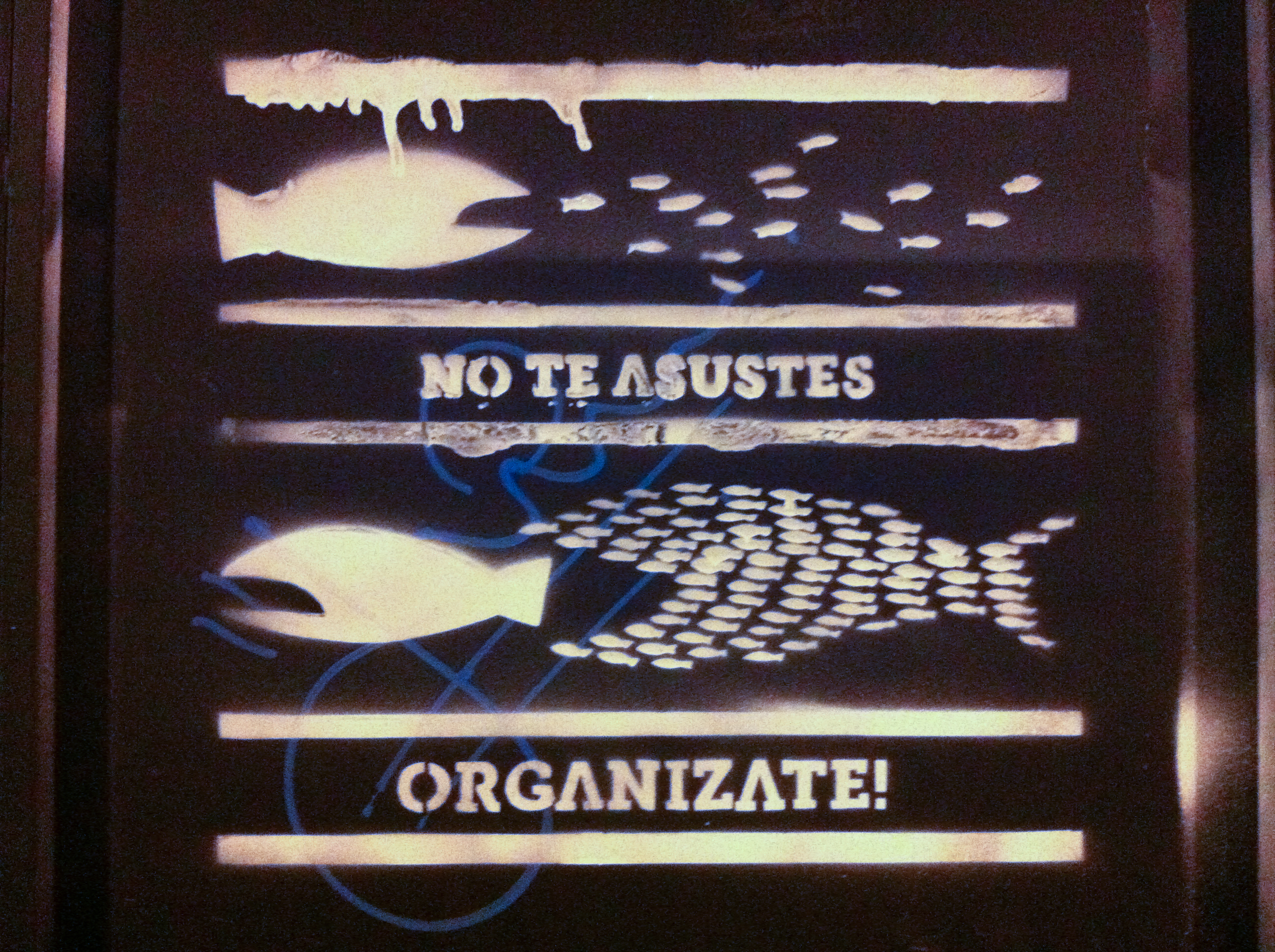
This metaphor sums up my argument. The top shows how government officials try to rule over minorities. The bottom shows many minorities and I joining together and amending an unfairness. We have a voice and can use our power.

One Fish, Two Fish, Red Fish, Dead Fish

In my last term for my STEAM class, I took a course called Frontiers. This term was the first ever time that course was introduced to GCE L...

Popular Posts